


Today is my daughter’s first day of school. Everywhere I look, we’re pretending it’s fall. My...
You know those posts that start with, “Something happened today that made me reflect…”? I have a bit of a love-hate relationship with those because they sometimes make me feel unoriginal, like something AI might produce. At the same time, most of my writing begins with curiosity or something I experience in everyday life, rather than from a planned theme or content calendar (I am a former marketer, after all).
With that said, something happened this week that made me reflect... 😆
I’m not great at meditating. Still, I do enjoy the daily Mindful Moment prompts my Headspace app serves up. This week, one of those prompts was about leaving room for silence and stillness so your intuition has space to surface. I'm still thinking about it, and here's why:
I get to see how intuition develops in real time through my coaching clients, most of whom range from their mid-20s to mid-40s. What fascinates me most is how our relationship with intuition evolves as we gain experience.
Early career: building first instincts
In the early years of a career, intuition develops through exposure to real situations and repetition.
My early-career clients are often still building enough experience to recognize patterns. They need time to see the same situation more than once. Then, over time, something clicks. They start to develop “spidey senses,” even if those hunches are faint at first.
The next challenge comes in learning to trust those instincts. Early-career professionals are still developing confidence in professional settings. Many are used to deferring to managers or more experienced colleagues. Authority feels external at this stage, so even when something feels off, they second-guess themselves.
Mid-career: trusting instincts, speaking up
By mid-career, most leaders have built strong instincts. They know how to read situations and anticipate reactions. They understand how to navigate conversations with clients, peers, and their own teams. In these settings, they trust themselves when they know the decision is theirs to make.
Then things change when they work directly with senior leaders.
Even confident mid-level leaders sometimes go quiet when a senior voice enters the conversation. With hierarchy in mind, they begin to defer again and may remain silent rather than speak up with potentially valuable insights.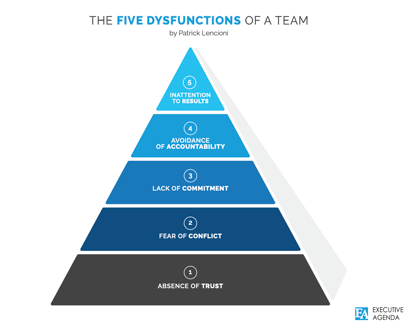
This is where strong teams separate themselves from average ones.
If you are familiar with The Five Dysfunctions of a Team, you know that productive conflict sits at the foundation of high-functioning teams. It is really about healthy debate and sharing of information rather than arguments or ego.
Senior leaders make better decisions when people around them speak up. Diverse perspectives add context and help surface risks that might otherwise be missed. All of this depends on trust.
People need to believe their voice belongs in the room. They also need to know that respectful disagreement is necessary and part of how strong decisions get made.
Senior leadership: creating space for others’ instincts
One of my C-suite clients often says, "Leaders have to hold their tongues at least 1,000 times a day." What he's really saying is that leaders reach senior roles because they have strong instincts, good judgment, and know how to read people and situations quickly. However, at this stage, their responsibility shifts to helping build that same muscle in the layers below them.
At the senior level, intuition becomes less about having the right answer and more about recognizing when others are developing their own instincts. It means stepping back so others can practice judgment and resisting the urge to take control.
Sometimes that includes allowing a junior leader to struggle or make a small mistake within safe boundaries. That experience builds judgment in ways no lecture ever could.
Making room for intuition
That Headspace prompt about silence and stillness resonates with me because intuition can't grow in a state of chronic noise. It develops when there is space to notice patterns, reflect on outcomes, and sit with uncertainty long enough to learn from it.
Early-career professionals need repetition to build instincts.
Mid-career leaders need courage to voice them.
Senior leaders need restraint to create space for others to develop theirs.
I think about this often in my own work, and I hope it's food for thought for you.